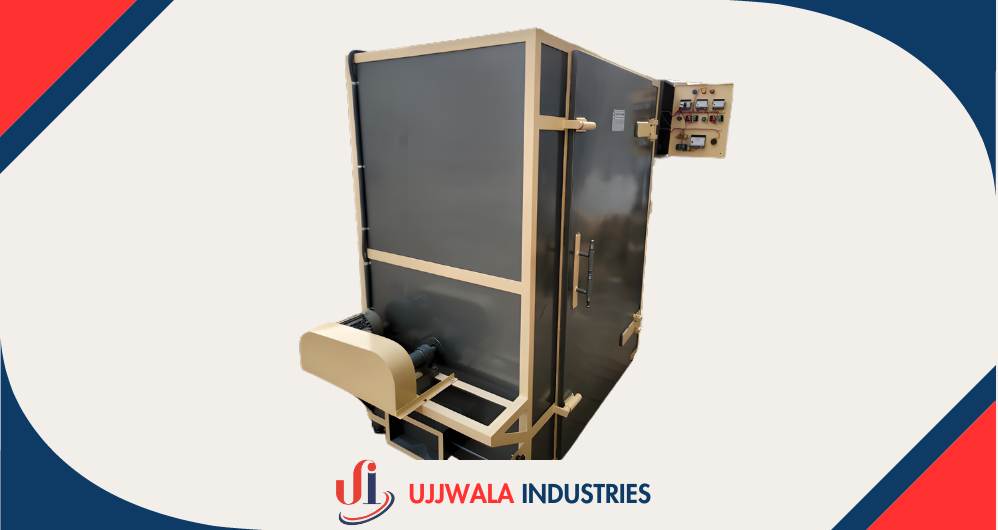

Tray Dryer

Use Of Product / Advantages

Uniform Drying: Tray dryers provide uniform drying across all trays, ensuring consistent moisture removal from the material being processed. This is crucial for maintaining product quality and characteristics.

Flexibility: Tray dryers are versatile and can handle a wide range of materials, including pharmaceuticals, chemicals, food products, and more. They can accommodate different tray sizes and configurations to suit specific drying requirements.

Batch Processing: Tray dryers operate in batch mode, allowing for better control over the drying process. This is advantageous when dealing with smaller quantities of materials or when different products require separate drying cycles.

Ease of Loading and Unloading: The design of tray dryers typically allows for easy loading and unloading of materials. Trays can be conveniently slid in and out of the drying chamber, facilitating efficient handling of the processed material.

Cost-Effective: Tray dryers are often more cost-effective than continuous drying systems, making them a preferred choice for industries with batch processing requirements. They are relatively simple in design, resulting in lower initial and maintenance costs.

Energy Efficiency: Tray dryers can be designed with energy-efficient features, such as insulation in the drying chamber, which helps minimize heat loss and reduce energy consumption during the drying process.

Controlled Drying Conditions: The design of tray dryers allows for precise control of drying parameters, including temperature, humidity, and airflow. This control is essential for achieving desired product characteristics and minimizing the risk of over-drying or uneven drying.

Compact Design: Tray dryers are often compact in design, making them suitable for facilities with limited space. Their relatively small footprint allows for easy integration into existing production lines or laboratory setups.

Ease of Maintenance: Tray dryers are typically easy to maintain due to their simple design. Cleaning and routine maintenance tasks can be performed efficiently, contributing to the overall reliability of the equipment.

Adaptability to Various Heat Sources: Tray dryers can be designed to use different heat sources, such as electric heaters, steam coils, or hot air generators. This adaptability allows for customization based on the specific heating requirements of the material being dried.

Applications

Pharmaceuticals: Drying of pharmaceutical powders, granules, and tablets after the formulation process. Production of dry drug substances for further processing or packaging.

Chemical Industry: Drying of chemical powders and compounds for various applications. Processing and drying of resins used in coatings, adhesives, and other chemical products.

Food Industry: Dehydration of fruits, vegetables, and other food products to extend shelf life. Drying of food products to create powders (e.g., milk powder, spice powders).

Ceramics and Glass Industry: Drying of ceramic products after shaping processes. Drying of glass products before finishing or packaging.

Textile Industry: Drying of dyed fabrics, yarns, and other textile materials.

Plastics Industry: Drying of plastic resins before molding or extrusion processes.

Environmental Applications: Drying of sludge from wastewater treatment plants for disposal.

Agriculture: Drying of agricultural products such as herbs, spices, and seeds.

Mining and Metallurgy: Drying of ores and minerals after processing.

Research and Development: Laboratory-scale drying experiments in chemical and pharmaceutical research.

Powder Production: Production of various powdered products for different industries.

Wood Industry: Drying of wood products to achieve the desired moisture content.

Cosmetics Industry: Drying of cosmetic powders and formulations.

Paper and Pulp Industry: Drying of paper products during manufacturing.

Paint and Coatings Industry: Drying of pigments, coatings, and paint formulations.

Mining and Metallurgy: Drying of ores and minerals before further processing.

Electronics Industry: Drying of electronic components and materials.

Building Materials: Drying of construction materials like cement, clay, and gypsum.

Powder Coating: Drying of powder-coated materials in the manufacturing of coated products.

Adhesives Industry: Drying of adhesive formulations before packaging.

Features

Trays: Trays are the main containers where the material to be dried is placed. They are typically made of stainless steel or other materials suitable for the specific application. Trays can be perforated or solid, depending on the desired drying conditions.

Drying Chamber: The drying chamber is an enclosed space where the trays are arranged. It is designed to create a controlled environment for the drying process, regulating temperature, humidity, and airflow. The chamber is often insulated to improve energy efficiency.

Heating System: Tray dryers are equipped with a heating system to provide the necessary heat for drying. Common heating sources include electric heaters, steam coils, or hot air generators. The heating system is responsible for raising the temperature inside the drying chamber.

Air Circulation System: An efficient air circulation system ensures uniform drying. Fans or blowers circulate heated air within the drying chamber, providing consistent exposure to the material on the trays.

Control Panel: The control panel houses instruments and controls for monitoring and adjusting drying parameters. Temperature controllers, timers, and other settings are included to regulate the drying process.

Exhaust System: An exhaust system is necessary for removing moisture or vapors generated during the drying process. It helps maintain the desired conditions within the drying chamber.

Temperature Sensors: Temperature sensors are strategically placed within the drying chamber to monitor and control the temperature, ensuring it stays within the specified range.

Safety Features: Tray dryers often incorporate safety features such as over-temperature protection, emergency stop buttons, and alarms to ensure safe operation.

Insulation: Insulation is used to minimize heat loss from the drying chamber, improving energy efficiency and maintaining a stable internal temperature.

Access Doors: Doors provide access to the drying chamber for loading and unloading trays, as well as for maintenance purposes.


Technical Specifications

Loading capacity10-12 Trays20-24 Trays25 Trays48-50 Trays96-100 Trays192-200 Trays
No of DoorsOneOneOneOneTwoTwo
No of BlowersTwoTwoTwoTwoTwoFour
No of motors /
H.P.3 Phase 415
Volts .
2/ 0.5 H.P.single phase 240 volt
1400 rpm
2 / 0.5 H.P.single
phase 240 volts 240 rpm
2 / 0.5 H.P.single
phase 240 volts 240 rpm
2/1 H.P.Three phase
415 volts 1400 rpm
2/1 H.P.Three phase
415 volts 1400 rpm
2 / 2 H.P.eachThree
phase 415 volts 1400 rpm
Electrical Heating
Load for 100 ° C /
200 ° C / 300 ° C
3kw6kw8kw12kw24kw36kw
Insulation in
mm100 ° C / 200 ° C
/ 300 ° C
505050757575
No of TrolleysRack SystemRack SystemRack SystemOneTwoFour
Tray Size32x16x1.5 Inch32x16x1.5 Inch32x16x1.5 Inch32x16x1.5 Inch32x16x1.5 Inch32x16x1.5 Inch
Trolley DimensionFixed RacksFixed RacksFixed RacksMovable TrolleyMovable TrolleyMovable Trolley
Testimonial

Customer Feedback

Get In Touch


    advanced revenue than this. Iwill refer everyone I know